

The Rise of AI in the Legal Profession: Will Artificial Intelligence Replace Lawyers?
Author: Rashi Yadav
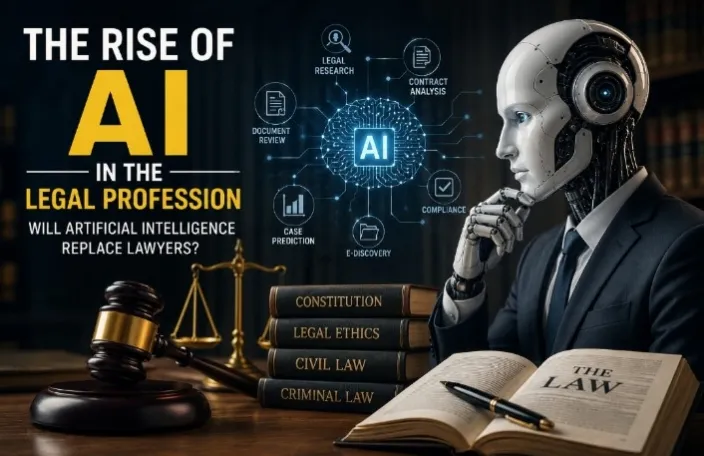
Artificial Intelligence (AI) is redefining the legal profession by transforming how legal services are delivered. From legal research and contract drafting to document review, compliance, and case analysis, AI-powered tools are improving efficiency, reducing costs, and enabling faster decision-making. As technology continues to evolve, a critical question emerges: Will AI replace lawyers?

AI has undoubtedly become a valuable asset for the legal industry. By automating repetitive tasks and analysing vast volumes of legal data with speed and precision, it allows legal professionals to dedicate more time to strategic thinking and client-focused solutions. This shift enhances productivity and expands access to legal services.
However, the essence of legal practice extends beyond automation. Advocacy, ethical judgment, negotiation, empathy, and the ability to interpret law within its social and human context remain uniquely human qualities. Justice is not merely the application of rules—it requires fairness, discretion, and compassion, attributes that no algorithm can truly replicate
.
The growing use of AI also raises significant concerns regarding data privacy, algorithmic bias, confidentiality, transparency, and accountability. These challenges highlight the need for a robust legal and ethical framework to ensure that AI supports, rather than compromises, the administration of justice.
Rather than replacing lawyers, AI is reshaping their role. The legal profession is moving towards a future where technological proficiency complements legal expertise. Lawyers who embrace innovation while upholding professional ethics will be best positioned to meet the demands of a rapidly evolving legal landscape.
Ultimately, the future of law is not a contest between humans and machines. It lies in a responsible partnership where AI enhances efficiency, while lawyers continue to safeguard justice, uphold the rule of law, and protect the values that define the legal system.